
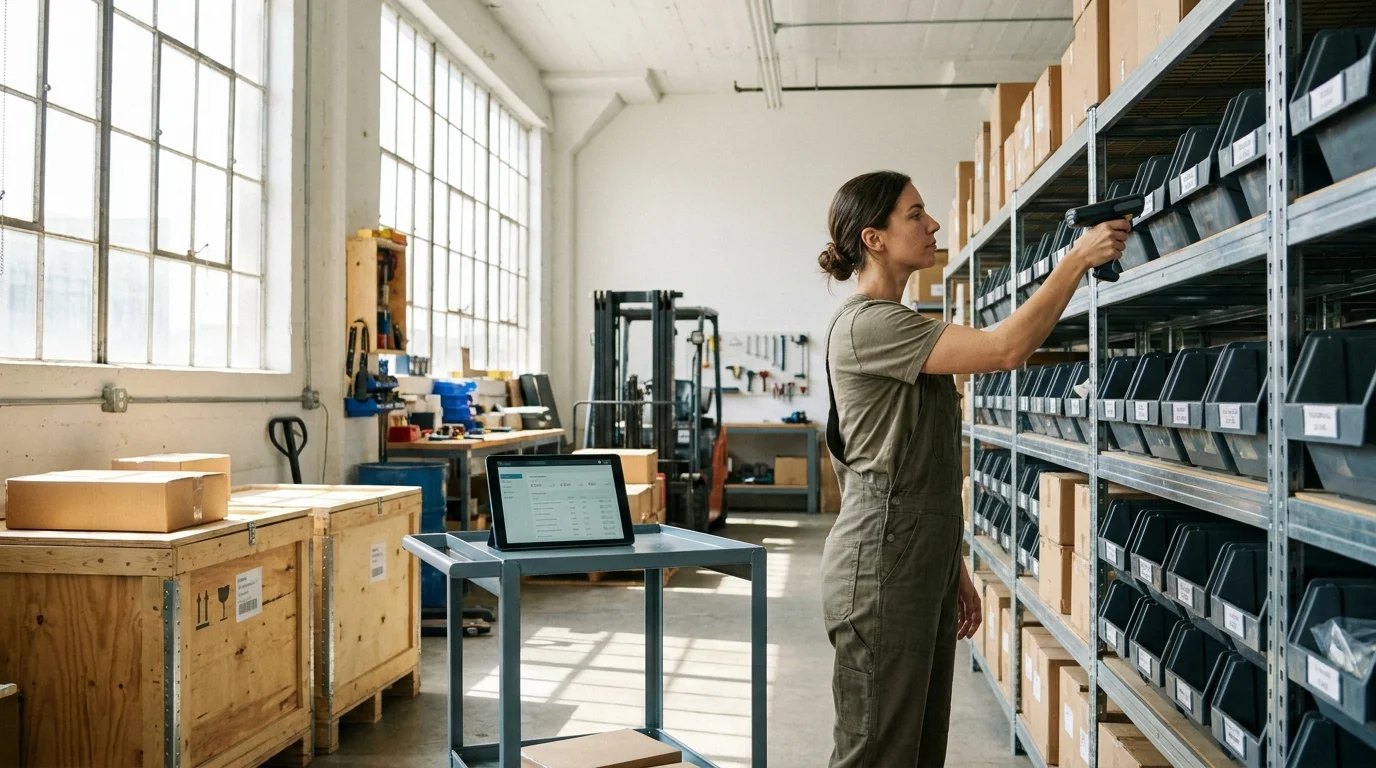
You open your storage room on a Monday morning. You need to restock the top-selling item before the week gets busy. But the shelf is empty. You thought you had 30 units left. You actually had 4.
This is how most small businesses manage inventory. Not because they do not care, but because manual tracking breaks down. Items get counted wrong. Reorder points get missed. The spreadsheet that worked fine when you had 50 products stops working when you have 500.
AI inventory management fixes this. It tracks what you have, what you need, and when you need to reorder, without spreadsheets and without guessing.
Why Inventory Tracking Breaks Down at Small Businesses
Big retailers have warehouse management systems, RFID tags, and dedicated logistics teams. They know exactly how many units shipped yesterday, what is selling today, and what will likely move next week.
Small businesses have a clipboard and a prayer.
Here is what that looks like in practice:
- Counts get done wrong. Physical counts take time. When time is short, counts get rushed. A rushed count means wrong numbers, which means wrong orders.
- Reorder timing is a guess. You reorder when the shelf looks low. But the shelf looks fine until it is suddenly empty. By then, you have already lost sales.
- Overstocking ties up cash. The safer response to uncertainty is to order more. But ordering more means money sitting on shelves instead of in your account.
- Manual tracking does not scale. The same process that worked at launch breaks down at 3x or 10x volume. Eventually, no amount of clipping and counting keeps up.
The numbers tell the story. Small businesses lose an estimated $1.4 trillion each year to inventory-related waste in the United States alone. A large share of that comes from small operations that do not have the systems to track accurately.
What AI Inventory Management Actually Does
AI inventory management is not just a digital list of what you have. It is an active system that monitors usage patterns, predicts demand, and triggers reorders before you run empty.
Real-Time Stock Tracking
AI connects to your point of sale, your suppliers, and your storage locations to track inventory in real time. When a sale happens, stock updates instantly. When a shipment arrives, the system records it. You always know where you stand without walking the warehouse.
Demand Forecasting
AI looks at your sales history, seasonal trends, and external factors like weather or local events to predict what you will need. A landscaping company knows that demand spikes after rain. A retailer knows that certain items sell more during specific months. AI builds these patterns into reorder recommendations.
Automated Reorder Alerts
You set the rules. AI enforces them. When stock falls below your reorder point, the system alerts you or automatically generates a purchase order. No more discovering you are out of stock when a customer asks.
Low Stock and Overstock Prevention
AI flags items that are running low before they become emergency. It also flags items that are overstocked, so you can pause orders and free up cash. For a restaurant watching food costs, or a retail shop managing seasonal inventory, this balance prevents both waste and lost sales.
The Real Cost of Manual Inventory Management
Manual inventory management is not free. It costs more than most small business owners realize.
Time cost
The average small business spends 8 hours per week on inventory-related tasks. That includes counting, reordering, checking deliveries, and reconciling what the system says versus what is actually on the shelf. At $40/hour, that is $16,640 per year spent on manual tracking.
Stockout cost
When you run out of a popular item, you lose the sale and potentially the customer. Research shows that 30% of customers who experience an out-of-stock situation do not return. If your average order is $75 and you lose 5 customers per month to stockouts, that is $22,500 in lost revenue annually.
Overstock cost
Overstocking ties up working capital and increases waste. A pharmacy that orders too much medication faces expiration costs. A garden center holding onto slow-selling plants loses shelf space for fast movers. AI helps right-size orders to match actual demand.
Shrinkage cost
Shrinkage is inventory that disappears without a sale. It includes theft, damage, misplacement, and administrative errors. For small retailers, shrinkage averages 1-2% of total inventory value annually. AI tracking makes shrinkage visible and harder to hide.
How AI Inventory Management Works in Practice
Here is how small businesses are using AI inventory management right now.
Retail and Ecommerce
A boutique clothing store uses AI to track which sizes and styles sell fastest. Before AI, they reordered based on gut feel. Now they reorder based on actual sales velocity. Stock turns faster and unsold inventory drops by 40%.
Food and Beverage
A brewery tracks kegs and ingredients in real time. AI monitors fermentation timelines and predicts when ingredients will run out based on brewing schedules. The result is fewer emergency ingredient orders and more consistent production.
Professional Services
A print shop manages paper, ink, and finishing supplies with AI. When a large job comes in, AI checks available inventory and flags if supplies will run short. This prevents the embarrassment of telling a client the job cannot be completed.
Trade Businesses
A plumbing contractor tracks van inventory across multiple vehicles. AI knows what each van carries and can suggest restocking routes based on usage patterns. Less time at the supply house means more time on jobs.
What to Look for in AI Inventory Management
Not all AI inventory tools are equal. Here is what matters for small businesses.
Integration with your existing tools
AI inventory management should connect to your point of sale, your accounting software, and your supplier portals. If it requires you to manually enter data from another system, you are just adding more work.
Mobile accessibility
You do not sit at a desk all day. Your inventory system should work on your phone so you can check stock levels from the job site or the storage room.
Supplier integration
The best AI systems connect directly to supplier catalogs and can generate purchase orders automatically. You review and approve, or let AI handle reordering for items below a certain threshold.
Waste tracking
Look for a system that tracks waste, expiration, and returns alongside stock levels. This gives you a complete picture of where inventory actually goes, not just where it should go.
Getting Started with AI Inventory Management
You do not need to overhaul your entire operation on day one. The most effective approach is to start where the pain is most visible.
If stockouts are your biggest problem, start with real-time tracking on your top 20 items. Get alerts before you run empty and build confidence in the data.
If overstocking is costing you, start with demand forecasting on your slowest-moving items. AI can show you which items tie up cash without earning their shelf space.
If manual counts are eating your time, start with automated stock tracking tied to your point of sale. Every sale updates inventory automatically. Fewer counts, more accuracy.
If shrinkage is your concern, start with a system that tracks inventory movement at every touchpoint. AI makes it harder for losses to go unnoticed.
The goal is not to add technology for its own sake. It is to stop losing money to inventory errors, stockouts, and waste. AI makes that possible at a scale that manual tracking never could.
Stop Losing Money to Inventory Problems
Every item you run out of is a lost sale. Every item you overstock is cash you cannot use. Every hour you spend counting is an hour you are not spending on your actual business.
AI inventory management gives you accuracy without the effort. It tracks what you have, predicts what you need, and alerts you before problems become emergencies.
The fix is simpler than you think. Your competitors who manage inventory manually are burning time and losing money every day. AI flips that equation.
For a detailed cost breakdown, see cost of AI inventory management for retail stores.