A buyer clicks "Get Price" on your website at 9:14 PM. By 9:17 PM, they have also filled out forms on two other dealership sites. The first dealer that responds gets the appointment. The other two are fighting for leftovers.
This is how car shopping works now. Buyers research online, submit multiple leads, and move fast. If your response takes until the next morning, you have already lost.
The same pattern plays out on the phone. A caller wants to know if you have a specific trim in stock. They want to book a test drive. They want to talk trade-in value. If nobody answers, they do not wait. They call the next dealership on the list.
AI for auto dealerships fixes this. It answers every call, responds to every lead, qualifies every buyer, and books every appointment -- whether your team is at lunch, in a meeting, or asleep. It turns the hours when your dealership is closed into hours when your sales funnel is still working.
Why dealerships miss more opportunities than they realize
Most dealership managers know they miss some calls. Very few know the real number.
Industry data shows that auto dealerships miss roughly 40% of inbound calls during business hours. After 5 PM and on weekends, that number climbs above 70%. Those are not just service calls. Research from CallRevu and Marchex shows that 54% of inbound dealership calls are sales opportunities -- people with intent to buy or lease who chose to call instead of submitting a web form.
The internet lead picture is just as bad. A study by Pied Piper found that 78% of dealership internet leads never receive a same-day response. The average response time across the industry is over 6 hours. By then, the buyer has already heard from competitors, scheduled test drives, and narrowed their list.
The cost adds up fast. If your dealership spends $45,000 per month on marketing and misses 40% of the calls it generates, you are effectively throwing away $18,000 in acquisition spend. Every missed call is not just a lost sale. It is wasted ad budget, wasted SEO effort, and wasted referral potential.
What AI does for auto dealerships
An AI virtual team for auto dealerships is not a voicemail system or a chatbot. It is a full front-end sales and service assistant that handles the work your BDC cannot scale to cover.
Here is what it does:
- Answers every call instantly. No hold music. No ringback. The caller hears a professional greeting with your dealership name and gets help right away.
- Responds to internet leads in seconds. When a buyer submits a form, the AI sends a personalized reply with next steps, inventory links, and appointment options before the buyer closes the browser tab.
- Qualifies buyers on the spot. The AI asks about vehicle interest, trade-in status, financing needs, and timeline. Your sales team walks into every conversation with context already attached.
- Books test drives and service appointments directly. The AI checks real-time availability and schedules appointments into your calendar without human back-and-forth.
- Handles trade-in and financing pre-qualification. It collects make, model, year, mileage, and condition details for trade-ins. It can also gather credit range, down payment amount, and monthly budget to pre-qualify buyers before they reach your finance manager.
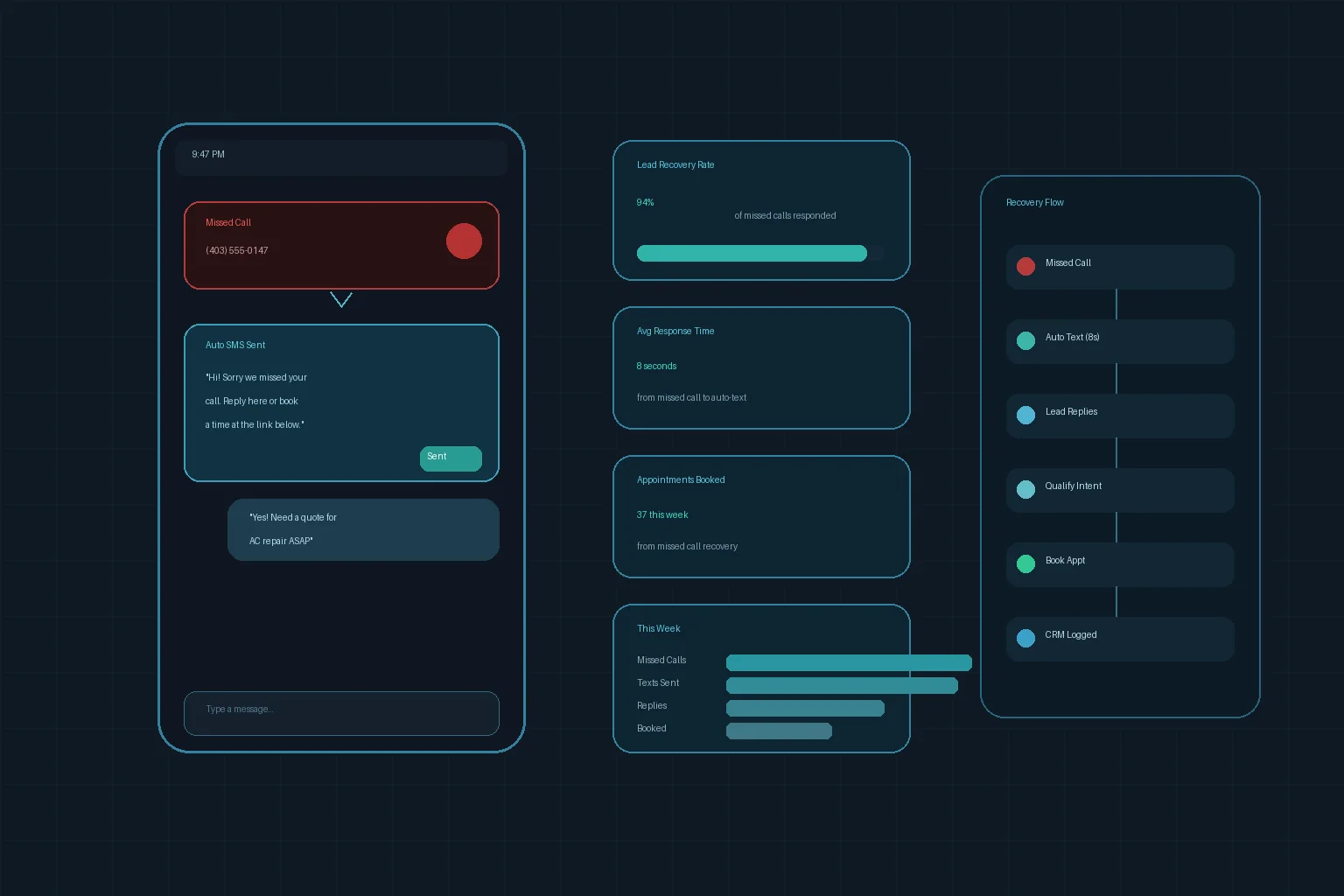
- Recovers missed calls automatically. When a call goes unanswered, the AI sends a text or places a callback within 30 to 60 seconds. Most buyers re-engage.
- Routes urgent calls to the right person. A claims emergency goes to your service manager. A VIP customer gets transferred immediately. A routine quote request gets scheduled for your next available block.
- Sends structured summaries after every interaction. Your team receives caller info, vehicle interest, qualifying details, appointment status, and any red flags. No more scribbled message slips or half-complete voicemail transcriptions.
This is how AI lead response for auto dealerships works in practice. It closes the gap between buyer intent and dealership response.
Where AI fits in the dealership workflow
Dealerships have clear workflows that repeat every day. AI works best when it slots into those workflows without forcing your team to learn new systems or change how they sell.
Sales call answering and lead capture
The phone is still the highest-converting channel for most dealerships. A caller is further down the funnel than someone who filled out a form. They want to talk now.
An AI receptionist for auto dealership businesses answers common questions right away. It shares hours, location, inventory availability, and pricing policy. It captures the caller's contact info, vehicle interest, and trade-in details. Then it either books an appointment or routes the call to the right salesperson with a full summary.
That matters more than most general managers think. If your BDC or floor staff loses 20 minutes of every hour to phone interruptions, that is nearly three hours of selling time gone in a single day.
Internet lead response and follow-up
Most dealerships get leads from their website, third-party sites, OEM programs, and social media. Those leads arrive at different times, in different formats, with different levels of detail. Some need instant response. Others need nurturing over days or weeks.
AI lead response for auto dealerships handles the first reply in seconds, not hours. It answers the buyer's specific question, shares relevant inventory, and offers next steps. For leads that are not ready to buy immediately, AI client follow-up for auto dealerships keeps the conversation alive with scheduled check-ins, trade-in reminders, and service offers.
Missed call recovery
Missed calls are not just lost conversations. They are lost revenue that your marketing budget already paid for.
When a sales call goes to voicemail, the buyer usually moves on within minutes. AI missed call response for auto dealerships captures those callers with an instant text or callback. It answers inventory questions, qualifies interest, and books test drives while the buyer is still in shopping mode.
Appointment booking for sales and service
Scheduling is one of the most time-consuming tasks in a dealership. Sales appointments, test drives, service visits, and recall work all require coordination between the customer, the calendar, and the staff.
AI appointment booking for auto dealerships standardizes that intake. It collects the customer's name, contact info, vehicle details, preferred time, and service type. Then it pushes the appointment into the right calendar without forcing a human to play phone tag.
Lead qualification and routing
Not every lead deserves the same amount of time. A cash buyer ready to purchase this weekend is different from someone six months out from a lease return.
AI lead qualification for auto dealerships asks the same screening questions every time. Vehicle interest. Trade-in status. Financing needs. Timeline. Budget. The answers help your sales team prioritize which leads to call first and which to nurture over time.
Customer support and service scheduling
Many dealership calls are not sales calls. They are service questions, parts inquiries, warranty issues, and appointment changes.
AI customer support for auto dealerships handles common questions without pulling service advisors away from customers who are already in the building. It can check service status, reschedule appointments, and route complex warranty or parts questions to the right department with full context.
Daily reporting and performance visibility
Most dealership managers already have data. The problem is turning it into something useful before the next sales meeting starts.
AI reporting for auto dealerships pulls together missed calls, response times, lead volume, appointment bookings, follow-up gaps, and BDC performance into one simple daily report. That gives managers a clear read on what broke, what improved, and where money leaked.
What this looks like on a live Saturday
Picture a Saturday at 10:30 AM.
Your sales floor is busy with walk-ins. Two of your salespeople are on test drives. The BDC is backed up with internet leads from the night before. The phone rings four times in ten minutes.
One caller wants to know if you have a specific SUV in stock. Another wants to book a test drive for Monday. The third is a service customer asking about a recall. The fourth is a buyer comparing your lease offer to a competitor's.
Without AI, those calls either wait, go to voicemail, or interrupt the floor.
With AI in place:
- The inventory question gets answered with real-time stock info and a link to schedule a test drive.
- The Monday test drive gets booked directly into the calendar with the customer's details attached.
- The recall question gets answered and the service appointment gets scheduled.
- The lease comparison gets a fast, accurate response with your current offer and an invitation to book an appointment.
Nobody on the sales floor had to stop what they were doing to make that happen.
That is the real value. It is not flashy. It is operational. It protects sales during the exact moments when sales usually slip.
AI vs. traditional options for dealerships
Most dealerships handle calls and leads in one of four ways. Here is how they compare.
Hire more BDC staff
A full-time BDC representative costs $35,000 to $50,000 per year plus benefits, taxes, and training. They work set hours. They take lunch breaks. They call in sick. They quit without notice.
Even with a full BDC, you still miss calls after hours, on weekends, and during peak volume. One person can only handle one call at a time. During busy periods, leads sit in queue or go unanswered.
Use a live answering service
Traditional answering services charge $400 to $900 per month. They answer calls live but generally take messages rather than booking appointments, qualifying leads, or answering inventory questions. You still spend mornings returning calls and playing phone tag.
Most answering services do not understand automotive sales. They cannot ask vehicle-specific questions, check inventory, or route leads by sales territory. The message you get is "Someone called about a car. Call them back." That is not enough to close a sale.
Let it go to voicemail
This is free, except for the lost gross. Most dealerships underestimate this cost until they track it. If your average front-end gross is $1,500 per vehicle and you miss just two sales calls per week, that is $156,000 in annual revenue leaking out of a hole you are not even looking at.
AI virtual team
An AI virtual team costs $500 to $1,500 per month as a flat rate. It answers every call instantly. It collects complete lead details. It books appointments directly into your calendar. It qualifies buyers. It follows up automatically. It works 24/7, including nights, weekends, and holidays. It never calls in sick and never forgets a script.
For most dealerships, the AI pays for itself the first time it captures a test drive booking that would have gone to voicemail.
How to set up AI for your dealership in under a day
Most dealerships can be live the same day. The setup process is straightforward.
Step 1: Configure your greeting and script. Define how the AI greets callers, what questions it asks, and how it routes different types of inquiries. This usually takes 30 to 45 minutes.
Step 2: Connect your inventory and calendar. Link your DMS or inventory feed so the AI can answer stock questions in real time. Connect your sales and service calendars so it can book appointments without double-booking.
Step 3: Set your coverage rules. Tell the AI which makes and models you sell, which sales territories you cover, which financing options you offer, and which service types you handle. It uses this to filter and route leads accurately.
Step 4: Define escalation rules. Set who gets notified for urgent calls, how they get notified, and what information is included. A customer with a breakdown might go straight to your service manager. A hot lead gets routed to your top closer.
Step 5: Test and refine. Call your own number. Submit a test lead. See how the AI handles different scenarios. Adjust the script based on real caller behavior. Most dealerships dial in their setup within the first week.
What to measure in the first 30 days
Dealership managers do not need more vanity metrics. They need numbers tied to revenue and gross.
Track these first:
- Missed calls before and after launch.
- Time to first response for web, text, and phone inquiries.
- Number of test drives booked by AI vs. by human staff.
- Lead-to-appointment rate for AI-handled leads.
- BDC hours pulled back from phone and inbox work.
- Service appointment bookings captured after hours.
Even small changes matter. Recovering three missed sales calls on a Saturday can pay for the system faster than most managers expect. Saving 90 minutes of BDC admin work per day also adds up fast across a month.
What AI should not own
AI is good at repeat work. It is bad at pretending every customer situation is simple.
Keep humans on:
- Complex negotiation and deal structuring.
- Upset customer recovery when the situation is emotional.
- VIP and repeat customer handling.
- Pricing exceptions and manager approvals.
- Trade-in appraisal and physical vehicle inspection.
The right setup is not AI instead of people. It is AI for the work that follows a pattern, and people for the work that needs judgment and relationship.
Common questions about AI for auto dealerships
Will buyers get frustrated talking to AI?
Not if you use it for the right tasks. Buyers care more about getting a fast, accurate answer than whether a human said hello first. The failure case is not AI. The failure case is no answer, a long hold, or a voicemail box.
Does this only help large dealership groups?
No. Single-point dealerships often feel the pain more because one missed call or one missed lead matters more to the month. Small teams also have less buffer, so admin work hits harder during peak hours.
How long does setup take?
Most dealerships can start with one workflow in hours, not weeks. The speed depends on how clear your rules are and how many systems need to connect.
Do I need to replace my DMS or CRM?
Usually not. AI works best when it sits on top of the tools you already use and handles intake, routing, follow-up, and reporting around them. Most platforms integrate with DealerSocket, VinSolutions, Salesforce, Reynolds, and other major automotive systems.
Can the AI handle both sales and service calls?
Yes. The AI qualifies by intent, routes sales leads to the sales floor, and service inquiries to the fixed ops desk. Complex warranty or parts questions are escalated with full transcript and caller context.
Will the AI interfere with my existing BDC?
No. AI works alongside your BDC. It captures overflow, after-hours, and weekend calls that your human team cannot cover. During business hours, it supports peak call volume so your BDC focuses on high-value interactions and follow-up.
The bottom line
AI for auto dealerships works when it solves real sales and service problems.
It answers calls during rush. It keeps internet leads from going cold. It books test drives while buyers are still shopping. It gives your BDC fewer inbox tasks and more time on high-value follow-up. It gives managers clearer numbers the next morning.
Start small. Fix the phone, the lead response, or the missed call recovery that hurts most. Once that workflow is stable, expand from there.
If you want to see how this works in a live dealership workflow, book a demo and we will show you the setup.
Compare lead response vs outreach software for auto dealerships side by side.